Last Saturday marked the start of wedding season for me, 5 more to go! I’m so looking forward to see my beautiful friends get hitched this year, and with all the wedding buzz around I decided the next set of DIY tutorials are crafts to help personalize the big day. The videos should be up in the next week or so, stay tuned…I can’t believe in only 2 weeks the channel has over 5,000 views, crazy! Thank you for all the support!
Category: DIY
DIY Chalkboard Platter
Here is the last video from the first set of DIY entertaining tutorials – check out the many uses for a chalkboard platter. Warning: this was the very first one that we shot, so clearly I had some warming up to do! It got a little easier the second time around, I just reviewed the rough cuts of the wedding tutorials and can’t wait for you all to see them.
Materials:
Tools:
- Paint Brush
Total cost: Under $20
Time: 20 minutes (minus drying time)
Steps:
- Make sure the plate is clean and dry.
- Paint the inner edge of the plate. Be sure to follow the directions of the chalkboard paint you are using, The Martha Stewart chalkboard paint requires you to wait at least 1 hour before doing the second coat.
- Write with the chalk to describe what you are displaying.
Various uses for the chalkboard platter:
- Cheese Serving Plate
- Beer (or your alcohol of choice) Tasting Platter
- Perfume Display
Tip:
- Turn it into a housewarming gift by including cheese knives, a monogrammed dish towel and a chalkboard pen. I also like the idea of writing the last name of the new home owner on the bottom of the platter, for example “The Brown House Est. 2013.”
DIY Food Allergy Menu Cards
I love hosting dinner parties but with food allergies on the rise it can often create a challenge for the host and the guest (I know from experience). If you are unsure, it’s not uncommon to ask your guests ahead of time if their diets have changed. Your guests will appreciate you going the extra mile to make them feel welcomed in your home. Check out my tutorial video on ways you can easily label the food for guests who have allergies. For more entertaining tips, subscribe to the Likeheared channel: http://www.youtube.com/iamlikehearted
Materials:
Total cost: Under $25 – $18 of this is for the Animal Stamps since I didn’t already own them
Time: 15 minutes
Steps:
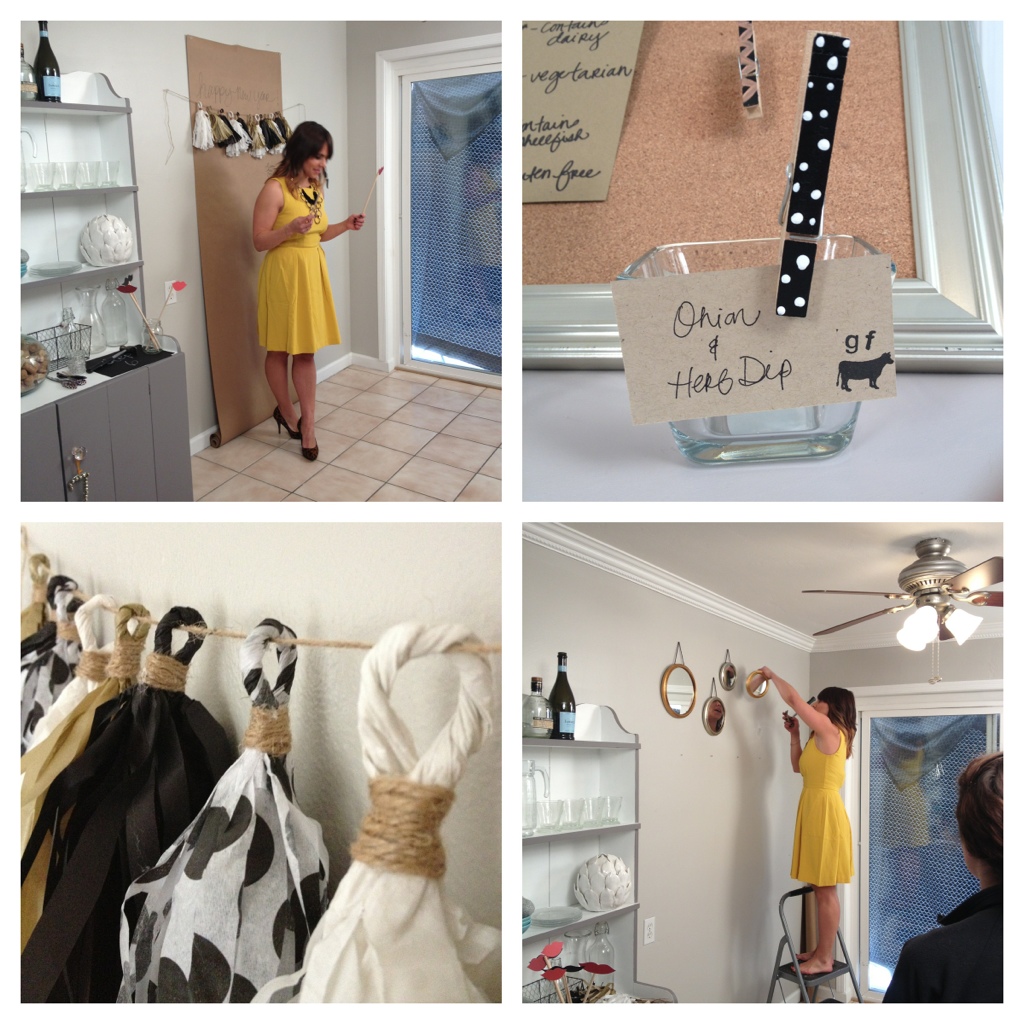
- Make a key letting your guests know what the stamps stand for. For example, I used the cow stamp to mean “contains dairy.”
- For the the menu cards I used the “business cards” from Papersource, they are pre-cut and just the size I needed.
- Write out the dish name on a menu card with a sharpie.
- Use stamps with ink pad to tell what allergies are in the food.
Allergy Free Entertaining Tips:
- Avoid cross contamination by using separate serving utensils with each dish.
- Keep all food labels in case someone wants to double check the ingredients.
- Ask guests to bring something other than food: bottle of wine, flowers or ice, that way you can control what food is served.
DIY Photo Booth & Props
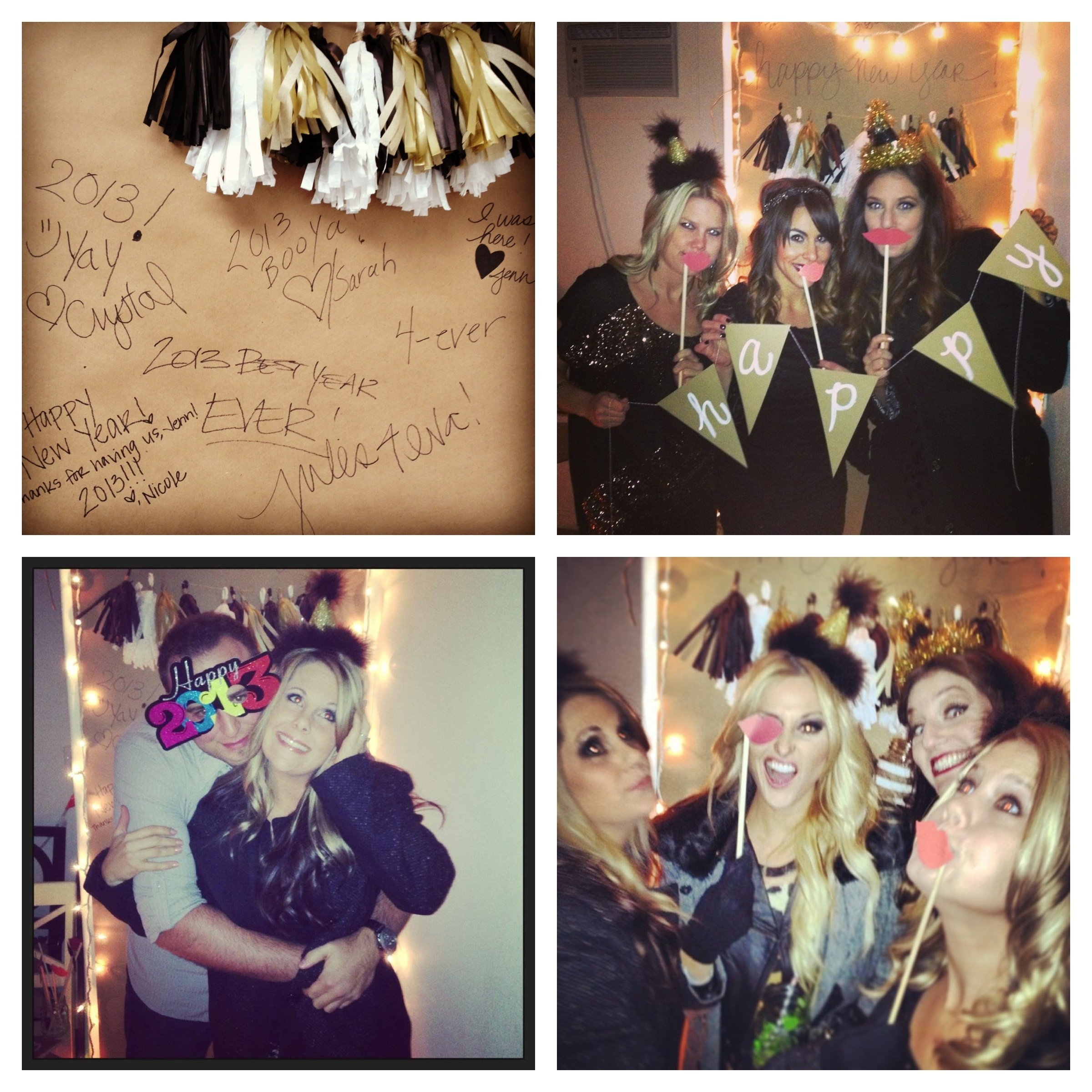
I hosted New Year’s Eve and decided to do a photo booth as a way to capture the night’s moments. Watch the video to see how to make your own and check out the photos at the bottom of the post for the final results!
Prop Materials:
- Card Stock Paper in black, red & pink
- Wooden dowels
Photo Booth Materials:
- Kraft Paper Roll
- Clear Push Pins
Tools:
- Scissors
- Hot Glue Gun
- Sharpie
Total cost: Under $10
Time: 30 minutes
Steps for Props:
- Draw freehand or download a stencil online for lips & mustache silhouettes.
- Trace the stencil onto the card stock.
- Cut out the shapes.
- Secure the shape to wooden dowel with a dot of hot glue.
Steps for Photo Booth:
- Find an area in your home that will function as your photo booth.
- Take the kraft paper and hang on wall with clear push pins.
- Decorate with tassel garland, white lights and/or other decor to match your theme.
Tips:
- Use the backdrop as a guest book and have party goers sign it.
- Write a hashtag (#newyearseve) on the backdrop as a reminder to guests to tag their instagram & twitter photos.
- If you have an old Polaroid camera feel free to bust it out or have your guests download the photo sharing app Flock onto their smartphones (you can send an invite to your friends to download the app before the day of the event).
Time to vote!
DIY Tissue Tassel Garland
The Likehearted YouTube Channel is live! I had a blast being a content contributor and getting to share my craft ideas. I’m so grateful for the opportunity that Sitewire has given me, and the beautiful work Snapfactory did on the videos. It’s definitely nerve-racking being on camera for the first time but I’m really proud of the videos and hopefully you all enjoy them too!! More videos to come, so make sure to check out all the tutorials by subscribing to my channel: http://www.youtube.com/iamlikehearted.
Materials:
- Tissue Paper
- Jute twine
Tools:
- Scissors
- Hot glue gun
Total cost: Under $10
Time: 2 hours
Steps:
- Fold one sheet of tissue paper in half width-wise, then fold it over length-wise.
- With your scissors, cut strips of fringe about 1/4 inch wide along the unfolded long edge of your folded tissue, leaving about 2 inches of uncut tissue at the folded edge.
- Unfold your paper and cut the tissue in the center, creating two halves. Set one aside.
- You should have a sheet of tissue with fringe on either side and a solid section down the center. Using the solid center section, begin to roll the tissue paper up, being careful to keep the fringe untangled.
- After the entire section is rolled, twist the center tightly. Then curl it in on itself to create a loop, and secure with a small dot of hot glue.
- For a finishing touch, place a small dot of hot glue under the loop and wrap twine around the base, secure with another dot of hot glue. Trim the ends if desired, and string your tassel onto your cord.
Tips:
- One sheet of tissue paper makes 2 tassels.
- I suggest about 16 tassels for your average size garland = 8 sheets of paper.
- To make tassels with longer fringe, during step 2 cut along the short edge of the unfolded tissue instead of the long edge.
Don’t have time to make your own? Purchase the one I made in the video on my Etsy shop.
Sneak Peek…
Sucker for Stripes
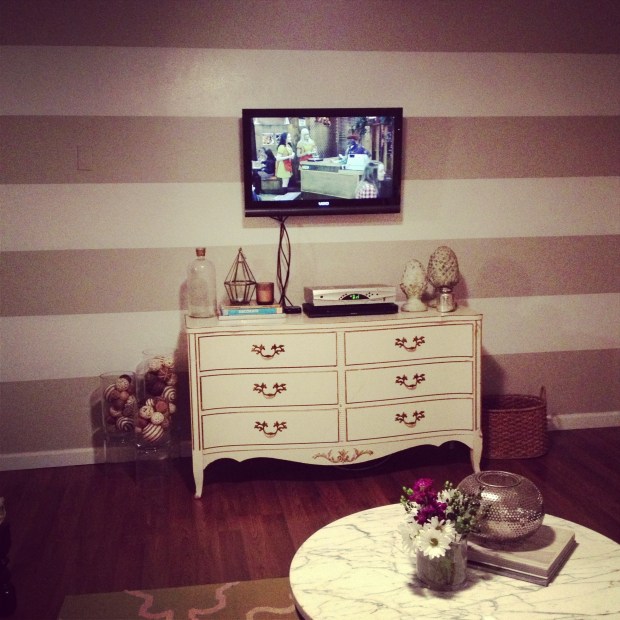
I’ve been in my house for almost a year and I’m at the point where I’m working on the finishing touches. I’m a sucker for stripes and never get tried of them, so after hanging my TV on the wall I thought they would be the perfect accent. After doing a bunch of research online for the best practices on painting stripes I decided to tackle the project and below is my take on it.
Materials:
- Tape measure
- Pencil
- 3m painters tape
- Level
- Disposable roller and paint tray
- Paint for your stripes (assuming you like the base color already on your wall)
Directions:
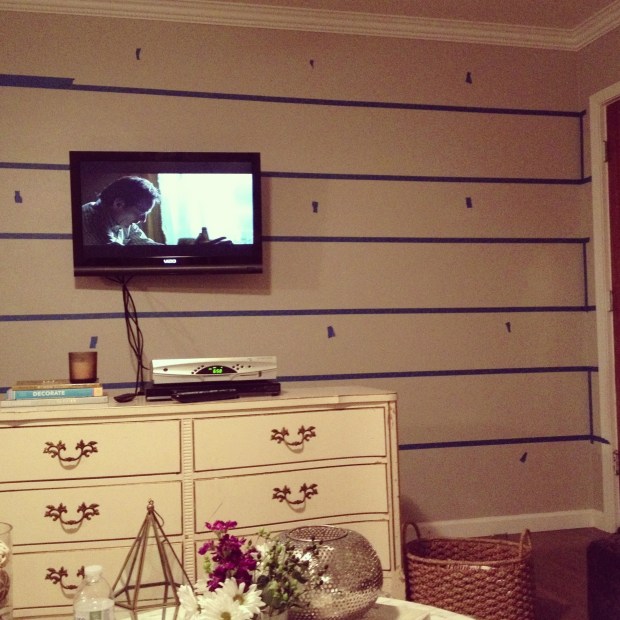
- Mark out the stripes – Measure the total height of your wall from bottom of your crown molding to the top of your baseboard. It’s best to use odd number of stripes. My total wall height was 90 inches, divide that by 7 = 12.8 inch stripes. If you want bigger stripes divide by 9, if you want smaller stripes divide by 5. Doing odd numbers gives you the ability to leave your base color as the top and bottom stripes, that way you don’t have to touch the crown molding or baseboards when painting. Cuts your time in half. Best tip I found, if you have “leftover” inches at the bottom, it is okay to make that stripe a little bigger, no one will notice!
- Tape out the stripes – I have a nifty laser level but I went old school with this and used just a regular level (I think I just haven’t taken the time to learn how to use the laser level). Just guide the level along the wall as you tape. Tip: I used pieces of tape as “Do not paint” markers on the sections that were not to be painted white.
- Paint! Once the second coat of paint is on and the stripe is fully filled in, take the tape off. No need to wait until it is completely dry, otherwise the tape will be glued to the wall.
Use disposable rollers and painter tray, it will only cost you a few dollars and definitely better to just throw that away then taking the time to clean them. I have a bad habit of leaving wet paint on brushes, so I take all measures to prevent this. But it never fails because as I type this it makes me realize I forgot to wash the brush I used to paint the corners (picture me running to my shed to confirm this and immediately putting the brush into cleaner).
In case you are wondering, my base wall color is Benjamin Moore Abalone and for the stripes I just used leftover paint that my trim and ceilings are painted which is Dunn Edwards White (eggshell finish). I still have accessorizing to finish and to hide those cable cords but that will be done in time. I read a quote the other day that I loved and made me appreciate what I have done over the last year and not worry that everything isn’t complete yet…”A home takes time to grow and become personal.” -Sania Pell, stylist/writer
PREP:
FINAL PRODUCT:
DIY Bachelorette Invites
My best friend since 3rd grade is getting married in April and I have the absolute pleasure of being her maid of honor. We are going to Austin, TX for the bachelorette party and I couldn’t be more excited. First order of business in planning the bachelorette weekend is the invitations. I wanted to do something personalize and custom to the Texas theme. I also included “next steps” on the back of the invite which I printed on white stock paper, cut down to size and secured with the Washi tape. I’m no graphic artist but I really love the way they turned out!
Materials:
1. Paper Bag Foil Printable Invitations – papersource (best part is that Papersource provides a downloadable word document template)
2. Washi Tape – I found this one at Target
3. A7 Paper Bag Envelopes – papersource
4. Downloaded new fonts “Creampuff” and “DS Dots” from searchfreefonts.com
Weekend Warrior Project # 3 – Side Chairs
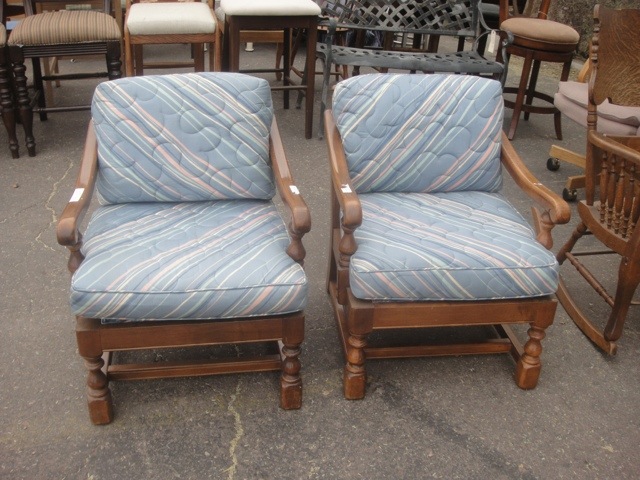
The “before” photo pretty much sums up this project. I instantly saw these diamonds in the rough and knew I had to have them. At $30 a piece it would be hard to pass them up.
BEFORE: Let me repeat, I got these for $30 A PIECE!!
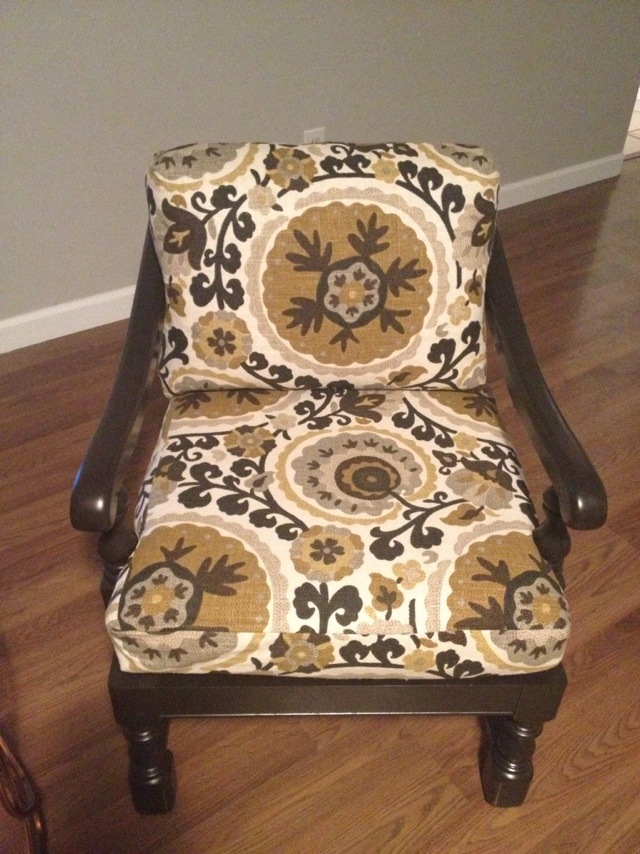
AFTER:
Here is how I did it:
- The fabric I found at Joann – the week they had 40% off of designer fabric. For about 3 yards it costed around $90.
- I was lucky enough to have a family friend recover the cushions (all it cost me was a good bottle of white wine!).
- I primed and painted the chairs with Rust-Oleum Painter’s Touch Ultra Cover 2x Coverage Primer/Paint in Dark Walnut (satin finish). Each chair took a can and a half, 3 cans needed in total.
- Total cost of the project: about $170